Green
Healthy environment
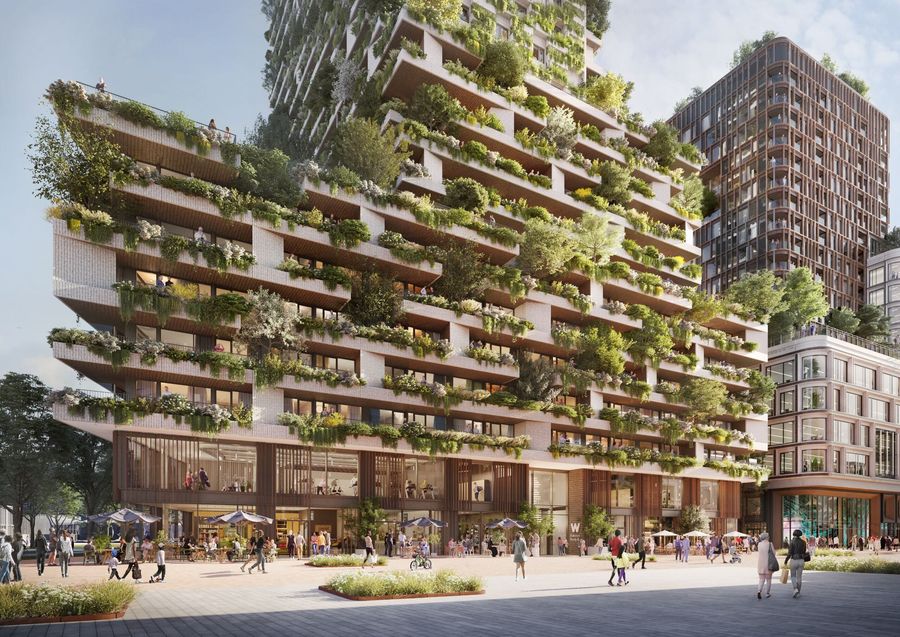
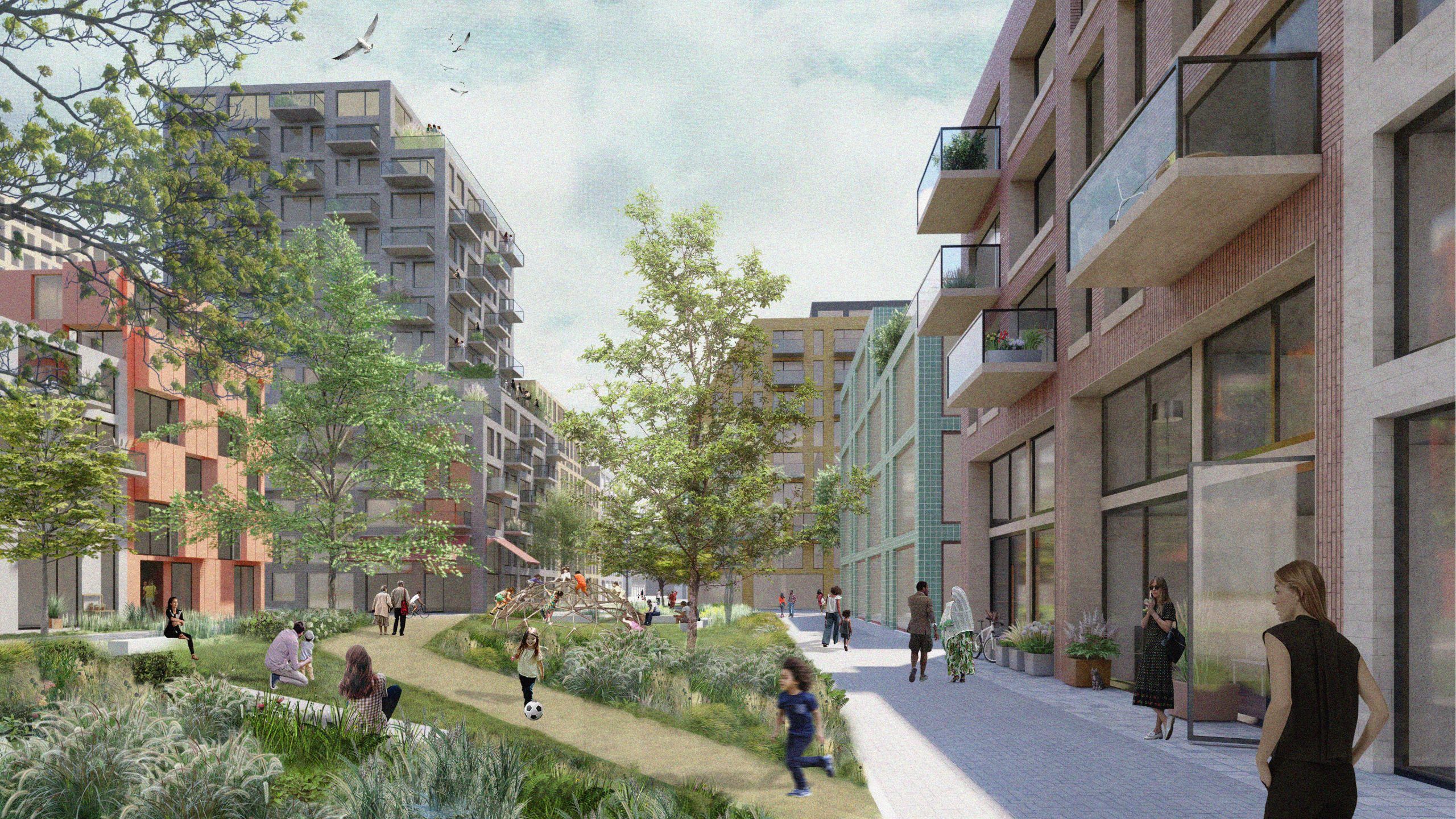
According to Finn, it will be a healthy and sustainable environment with lots of greenery. Outside is the place for cyclists and pedestrians, nature and meeting, rest and clean air. “Our aim is a big park with buildings and not a neighborhood with occasional greenery. We are giving the space back to the people.”
Car-free
Over 10,000 people can live in Merwede.
“It will be a neighborhood with a large number of residents on about 24 acres. That’s a fairly limited amount of square footage. Therefore, it is important to design the available public space with great attention. This can be done by making the neighborhood car-free. We encourage residents to bike, walk and use shared cars and public transportation.”
©Bura Okra
Nearby
Walking or biking
Therefore, everything that neighborhood residents need on a daily basis is within walking or biking distance. “The supermarket and the school is closer to home than the car,” he said. In Merwede, in fact, there is not a parking space for every household. Underground parking garages at the edge of the neighborhood have a total of about 1,800 parking spaces. Against 25,000 bicycle parking spaces in the buildings. According to Finn, Merwede suits Utrecht. "There is already a lot of cycling in our city and a lot of employment opportunities. Moreover, Utrecht is not afraid to try things out. Other cities have not yet been willing to realize a car-free district. The municipality is quite brave in daring to take a big step forward."
Living environment
Health gains
By abandoning the car and being mindful of nature, Merwede contributes to a healthy living environment. Physically and mentally.
“We are building a better neighborhood than what exists now. In Merwede, people are automatically on the move. Rest and space also contribute to mental health. Among other things, a green environment helps with mental well-being, heat stress and water storage. This approach can yield enormous health benefits.”
Added value
Community spirit
He also calls the space for meeting an added value. For example, people from Merwede and surrounding neighborhoods can meet each other at neighborhood spots: two large plazas and a number of small and medium-sized spots created together with residents. “I hope that community spirit is the strength of Merwede. Really together for the neighborhood.”
© Juri Hiensch
© Juri Hiensch
Area organization
Area organization
Merwede is getting something else new: a kind of VVE for the neighborhood. Area organization Merwede’s main tasks will include filling in the logistics side with service stores, parcel walls and light electric vehicles, as well as the appointment of one or more neighborhood concierges to serve as eyes and ears in the neighborhood.
“You don’t see this yet in other neighborhoods, because residents there don’t share much with each other. In Merwede, the public space is different.”
Sustainability
But not only the approach to urban planning is innovative in Merwede. There are also special solutions in the area of sustainability.
For example, the houses will have building insulation made from fungus and wood chips instead of the more traditional rock wool. There are also reusable bricks that snap together, without mortar. And cladding panels that are also solar panels. A thermal storage system that extracts energy from the ground heats and cools the buildings. This also utilizes the heat from the Merwede Canal. As a result, there is a comfortable temperature all year round without drawing on natural resources. Finally, every square inch of roof is used for green roofs, urban agriculture, roof terraces or solar panels.
Solutions
Merwedelab
In the Merwedelab, the municipality and developers together translate innovative products and ideas into concrete, practical solutions. “For example, how do we turn bicycle parking facilities into places where people enjoy meeting each other?” But there is also a team working on animals and nature to ensure that birds, bats and hedgehogs, among others, find their home in Merwede.
Unique
Experiment
Finn sees Merwede as both an opportunity and an experiment. “Realizing a car-free neighborhood isn’t happening anywhere yet. It also raises challenges, such as parcel delivery and accessibility for emergency services. We are all coming up with solutions for that. It’s a fun process. If soon everything works well, we may be an example for other cities. In the Netherlands and worldwide.”
Finn Van Leeuwen
Project manager mobility Merwede Finn van Leeuwen has been involved in urban development and mobility transition projects in several cities. In Utrecht he’s responsible for developing and implementing the district’s mobility concept, focussing on both people and things. On the one hand, it’s about what needs to be built – such as garages, bicycle parking, and public spaces – on the other, it’s about how the city functions and what’s needed for this – investigating shared mobility solutions, who gets access to the car-free area under which conditions and how waste collection is organised.
Niel Glas
Niel Glas has been involved in urban development in Utrecht for over 20 years, during which time he has been responsible for the creation of neighbourhoods in the west side of Utrecht. Together with the site owners and the city, Niels has spent the last five years developing the plans and contracts for the transition of Merwede from an inner city industrial site to a mixed and green neighbourhood. He focusses on the quality of the buildings and public space both for people and nature. He enjoys the challenges of creating a high density and car free public space inside the city and the possibilities that these conditions offer to create shared public spaces for healthy urban living and recreation.